


Turkish Meze: A Guide to the Meze Table at Queb Rooftop
Ask someone who has spent a long evening at a Turkish table what they remember best, and the answer is rarely the main course. It is the meze. Those small plates arrive first, they cover the table from edge to edge, and they stay there for hours while the conversation moves on without them. At Queb Rooftop, our terrace above Sultanahmet, almost every dinner begins the same way: a row of meze bowls, warm bread, and Hagia Sophia lit up just behind the railing.
This guide explains what meze actually is, which meze you will find on our menu, how to build a table without over-ordering, and why a rooftop in the historic peninsula is a particularly good place to eat them.
What Is Meze, Exactly?
Meze is not a starter in the European sense. A starter is something you finish before the next course arrives. Meze is a stage of the evening. The word travelled into Turkish from Persian, where it described a taste or a relish taken alongside a drink, and that origin still explains the format: small portions, sharp flavours, and a rhythm that is meant to be slow.
A proper meze table is built on contrast. Something creamy sits next to something acidic. Something smoky sits next to something fresh. Nothing on the table is designed to fill you up on its own, which is exactly why people keep reaching for one more spoonful. If you have already read our guide on Turkish table etiquette and dining traditions, you will recognise the logic: the table is shared, the pace is deliberate, and no one is in a hurry to reach the main course.
Meze also solves a practical problem for travellers. Sultanahmet menus can look intimidating when every dish is unfamiliar. Ordering a spread of small plates is the cheapest, lowest-risk way to taste eight things instead of committing to one. It is the reason we recommend it to almost every first-time guest who asks us what to eat in Sultanahmet.
The Cold Meze on the Queb Rooftop Menu
Our cold starters section is the heart of the meze table, and each item earns its place for a different reason.
Humus is the anchor. Mashed chickpeas, garlic, lemon juice, vinegar, sesame tahini and olive oil, whipped until it is smooth enough to hold the shape of a spoon. It is the plate that everyone reaches for first, and the one that empties first.
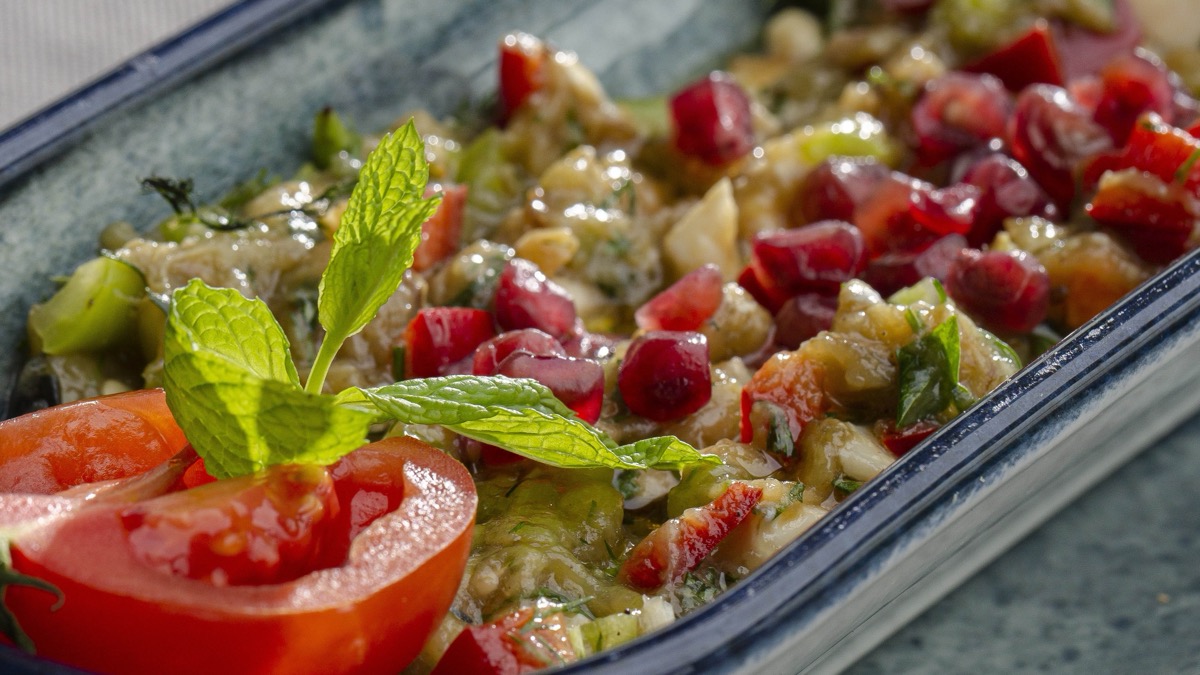
Spicy Antep Paste is the counterweight. Chopped tomato, pepper, fresh spices, lemon, tomato paste, pepper paste, olive oil and pomegranate, chopped rather than blended so it keeps its texture. It carries real heat, and it is the meze that most clearly signals you are eating in Turkey rather than anywhere else in the Mediterranean.
Babagannush brings smoke. Roasted aubergine and roasted pepper are marinated with lemon, olive oil and garlic, and the char from the roasting is the whole point. If you only order one aubergine dish, order this one.
Haydari cools everything down. Strained yoghurt, mint, dill, garlic and salt — thick enough that a spoon stands up in it. On a table with Antep paste and muhammara, haydari is the plate that lets you keep going.
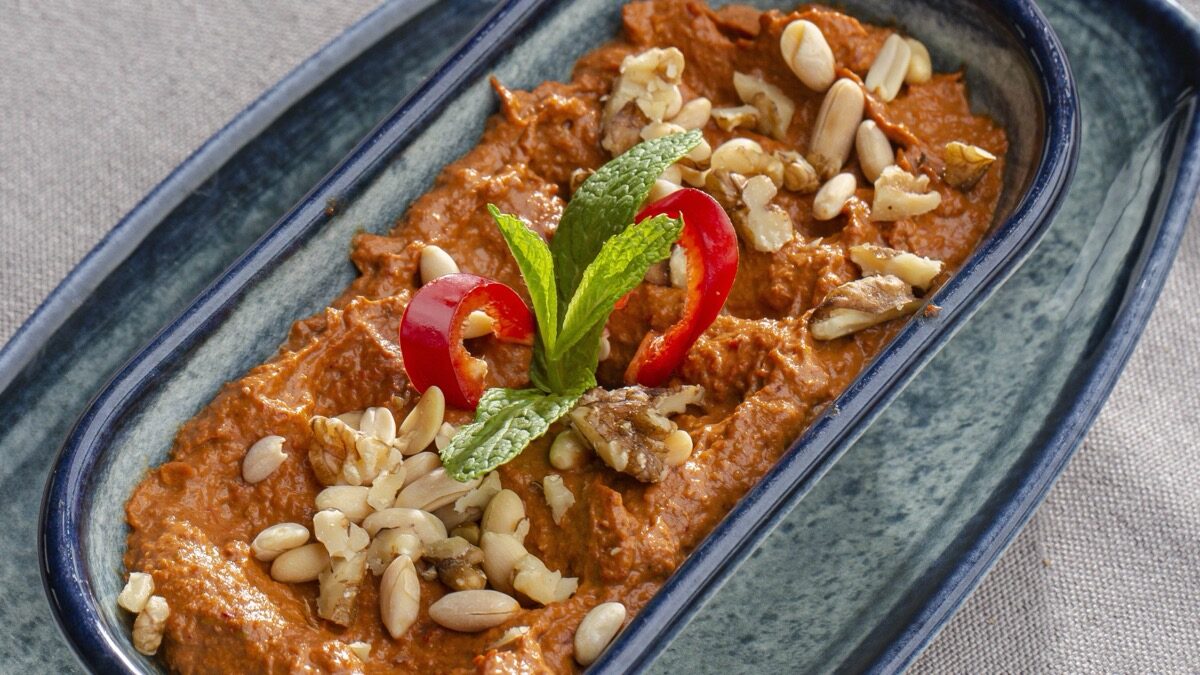
Stuffed Grape Leaves are the classic olive-oil meze: grape leaves wrapped around rice, served cold, eaten with a squeeze of lemon. Muhammara is the walnut-and-pepper paste, bound with bread crumbs, pepper paste, garlic, cumin and olive oil, and it is the most underrated item in the section. Imam Bayildi is the one dish here that is substantial enough to eat as a light main: roasted aubergine baked with sautéed onions, garlic, tomatoes, currants, peanuts and spices.
If choosing between them feels like too much work, the Mixed Meze Platter for two solves it. It is a tasting presentation of five types of daily fresh appetisers, chosen by the kitchen that morning. Guests who want cheese on the table instead order the Cheese Platter: white cheese, village cheese, smoked cheese, grilled halloumi, cheddar and braided cheese.
Warm Plates That Belong on the Same Table
A meze table does not have to be entirely cold. In Istanbul the hot starters arrive a few minutes later, once the cold plates have settled, and they change the temperature of the meal in both senses.
Grilled Halloumi Cheese, served with a side of arugula, is the simplest of them and the easiest to share. Hummus with Pastrami takes the plate everyone already knows and puts Turkish pastırma, cumin and black pepper on top of it. Garlic Mushroom arrives as a casserole of mushrooms sautéed in butter with yellow cheese, still bubbling.
Spring Roll — pastry filled with cheese and dill — and Hunter Pastry, a rolled pastry of yellow cheese and pastrami served with greens and soy sauce, cover the börek side of the table. Yandim Hacer is the one to order if you want something with more character: roasted aubergine, walnuts, cheddar cheese, pastrami and hot spices, served in a casserole dish.
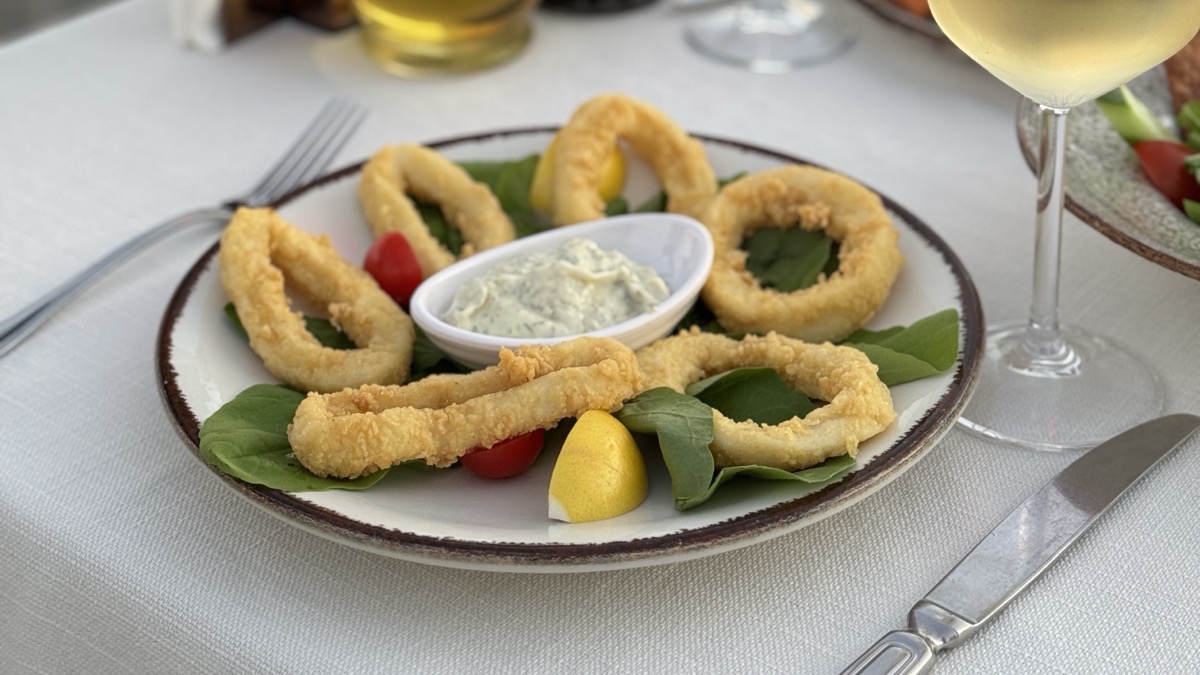
From the sea, Fried Calamari with tartar sauce is the safe crowd-pleaser, while Shrimp in Garlic — shrimp, butter, garlic, thyme and chili pepper — and Shrimp Risotto Balls are the two the kitchen recommends most often. All of them work alongside meze rather than competing with it.
How to Build a Meze Table Without Over-Ordering
The most common mistake is ordering meze the way you would order starters: one per person. That is roughly double what a table needs.
A workable rule for four people is four to five cold plates and two hot ones, then a shared main course afterwards. For two people, three cold meze and one hot plate is generous. The Mixed Meze Platter counts as roughly three plates on its own, so build around it rather than adding to it.
Balance matters more than quantity. Aim for one creamy plate (humus or haydari), one smoky plate (babagannush), one spicy plate (Antep paste or muhammara), one leaf-or-vegetable plate (stuffed grape leaves or imam bayildi), and one from the sea if you plan to continue with fish. That combination covers every texture the table needs.
Order the hot starters after the cold ones have arrived, not at the same time. Bread is not optional; ask for more when it runs out. And leave the main course decision until the meze is on the table — you will almost always want something lighter than you originally planned. Our Sultanahmet dinner guide walks through how the rest of the evening usually unfolds from that point.
What to Drink Alongside Meze
Meze evolved next to a glass, and the pairing is not accidental. The traditional partner is rakı, the aniseed spirit that turns cloudy when water is added, and its liquorice edge is designed for exactly the salty, garlicky, lemony flavours on the table. Rakı is sipped slowly with water on the side; it is not a shot, and it is never rushed.
If rakı is not for you, a dry white wine handles the cold meze well, and a light red works once the hot plates and any grilled dish arrive. For guests who do not drink alcohol, fresh lemonade or ayran — the salted yoghurt drink — is the honest Turkish answer, and ayran in particular is a better match for spicy meze than most people expect.
Whatever is in the glass, the important part is the pace. A meze table is measured in hours, not minutes, and the drink is there to slow the evening down rather than speed it up.
Meze With a View: Why the Rooftop Matters
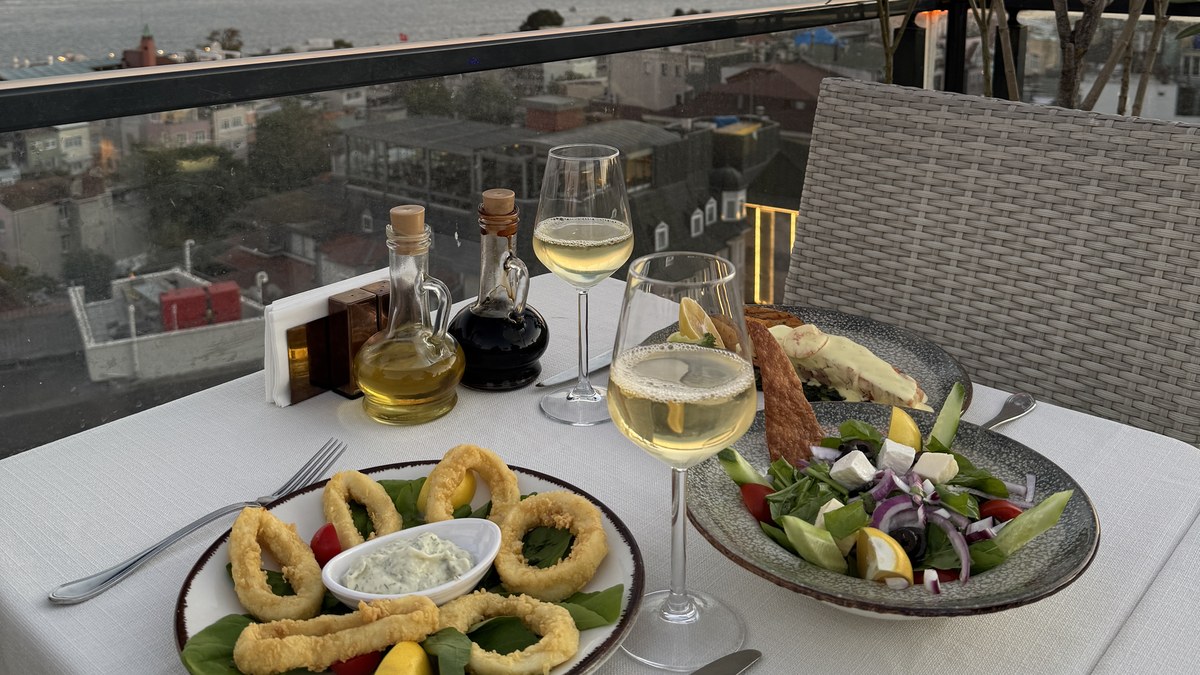
There is a practical reason meze suits a rooftop. Because the plates stay on the table and nothing needs to be eaten immediately, a meze dinner leaves you free to look up. At Queb Rooftop that means the domes and minarets of the historic peninsula on one side and the Sea of Marmara on the other, changing colour through the whole meal as the sun goes down and the monuments are lit.
We sit on top of the Byzantium Hotel in the middle of Sultanahmet, a few minutes on foot from Hagia Sophia, the Blue Mosque and the Basilica Cistern. Guests usually arrive from sightseeing, sit down with meze while their feet recover, and only think about a main course an hour later. If you are still comparing terraces, our overview of the best rooftop restaurants near Hagia Sophia explains what to look for.
Timing helps. Arriving around forty-five minutes before sunset means the cold meze lands in daylight, the hot plates arrive during the golden hour, and the main course is served once the mosques are illuminated. Booking a table in advance is worth it on summer evenings; the railing seats fill first.
Frequently Asked Questions About Meze
Is meze vegetarian? Most of the cold meze on our menu are: humus, Antep paste, babagannush, haydari, stuffed grape leaves, muhammara and imam bayildi all are. Among the hot plates, grilled halloumi and garlic mushroom are vegetarian, while hummus with pastrami, hunter pastry and yandim hacer contain meat.
How many meze should we order? Roughly one plate per person plus one for the table, then stop and reassess. It is always easy to add another round.
Is meze a full meal? It can be. Four or five plates with bread will comfortably feed two people, especially if one of them is imam bayildi. Most guests still order a main course to share.
Is meze eaten at lunch too? Yes, though the classic long meze table belongs to the evening. At lunch most guests order two or three plates rather than a full spread.
Do we need a reservation? On summer evenings and at sunset, yes. The terrace is not large and the best tables are requested early.
Starting the Evening the Right Way
Meze is the part of a Turkish dinner that is hardest to explain and easiest to enjoy. It is not a course, it is not a snack, and it is not something to hurry through on the way to the grill. It is the reason the evening lasts four hours instead of one.
If it is your first dinner in the historic peninsula, start there: a mixed meze platter, warm bread, a cold drink and a seat facing the domes. Order the main course later, once the table has told you what you actually want. It is the way Istanbul has eaten for a very long time, and on a terrace above Sultanahmet it still makes more sense than anything else on the menu.
Recent posts


